
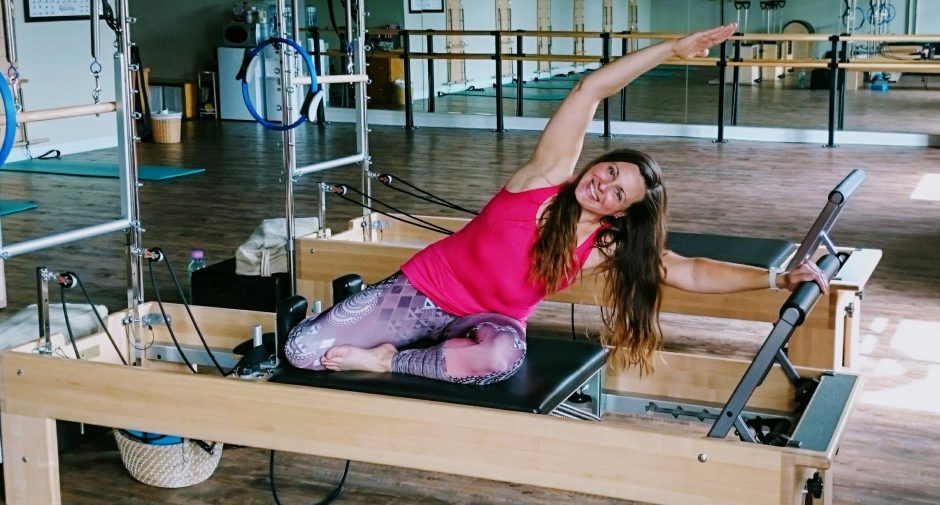
(Above picture of me courtesy of Meghan Cameron @ Hana Pilates)
When I tell someone I teach Pilates the first reaction I get is usually a confused but generally positive “oooooh.” Occasionally it may or may not be followed up with a “what is Pilates?” Most of the time though there are no further questions because people have lives to get on with and I could LITERALLY go on for as long as anyone would be fool enough to stand there and listen. Even when there may not be any further questions I bet they’re thinking it because like many other modalities of physical fitness the execution of it varies widely. I have found that Pilates gets placed alongside Yoga constantly and understandably so. As far as I can tell both disciplines have a very strong mind body connection. They require a lot of concentration and deal heavily with breathing and stretching. Full disclosure: I really can’t speak from first hand knowledge of Yoga since I do not do yoga but I am going off the knowledge I’ve acquired from my clients (verbally and physically) who are well versed in both Pilates and Yoga. Plus this blog is more about what Pilates is and not what Yoga is. So, just trust me when I say Pilates is not Yoga.
Now just a very brief overview of the history of Pilates. It was a discipline developed by a man named Joseph H. Pilates (but we will refer to him as Joe). Joe was a sickly lad so he embraced physical fitness as a way to cure what ailed him. As a German he was drawing upon a LONG history of creation and deployment of physical fitness disciplines from Scandinavians including but not limited to Medical gymnastics. It was developed during WWI while Joe was stuck cooling his heels in internment camps (or perhaps POW camps) after emigrating to England (or being captured in England). When he later moved to New York City in the 1920s he began to associate with George Balanchine who was one of the founders of the New York City Ballet. I go out of my way to let my students know (especially my male students) that it was developed originally on men and that only later on did it become associated more with dancers and thus women.
Pilates is for EVERYONE and should not be pigeonholed into something that is specific to only one group of people. In fact, one of my favorite things is working with exceptionally strong men or women who have never done pilates. In very few movements I am able to give them a very intense workout. This is because the Pilates method works ALL of the muscles. ALL of them! I’m not joking. Traditional methods of fitness put a lot of focus on a few muscle groups. We all know about our traps and lats and pecs but Pilates also uses your small supportive muscles as well (hello anterior and posterior serratus, transversus abdominis and what’s up quadratus lumborum). This is why it is so easy to make traditionally fit people work so hard – I make them use muscles that are neglected. I also make them stretch which is something that traditionally fit people (and MOST people) do very little of. The combination of strengthening and stretching the muscles in the body within the body’s natural range of motion is what leads to a balanced all over physical fitness. As mentioned at the outset I could go on about Pilates forever and I have EVERY intention to. My next blog will focus on what to expect from a Classical Pilates class or session and how to recognize a legit Pilates teacher (and class or session for that matter!).
 Official Website of Align Rochester Fitness
This post motivated me to go back to Pilates classes. I wish I lived near you so I could take a class from you.
Me too!!!